

When Doing Your Job Produces Harm
Why Modern Corporations Produce Outcomes No One Would Defend—Yet Everyone Enables

In 1937, a young British economist asked a brilliantly simple question: If markets are so efficient at organizing economic activity through prices, why do companies exist at all?
Ronald Coase’s answer, captured in his paper, “The Nature of the Firm,” changed how we think about business forever: Firms exist, he argued, because they’re better at certain things than markets—they eliminate the endless costs of finding people, negotiating prices, writing contracts, and enforcing agreements for every single task. Inside a firm, you don’t haggle with your colleague over every operational activity—the boss just tells both of you what to do. Command-and-control beats constant contracting. Efficiency wins.
Coase was right. Spectacularly right. Eventually, although it took 54 years, his insight earned him the Nobel Prize in Economics in 1991—and, by then, his logic had become the bedrock of modern corporate theory. But here’s what the 26-year-old Coase couldn’t have foreseen in 1937—an erosion of corporate moral responsibility: The very efficiency that makes firms superior to markets would, decades later, create the perfect conditions for collective ethical blindness.
In hindsight, though, we can see it: The same organizational structures that minimize transaction costs also (1) fragment moral reasoning, (2) diffuse responsibility, and (3) transform decent people into cogs in machines that produce outcomes no individual would stomach if they saw the whole picture. Grappling with this systemic reality matters now.
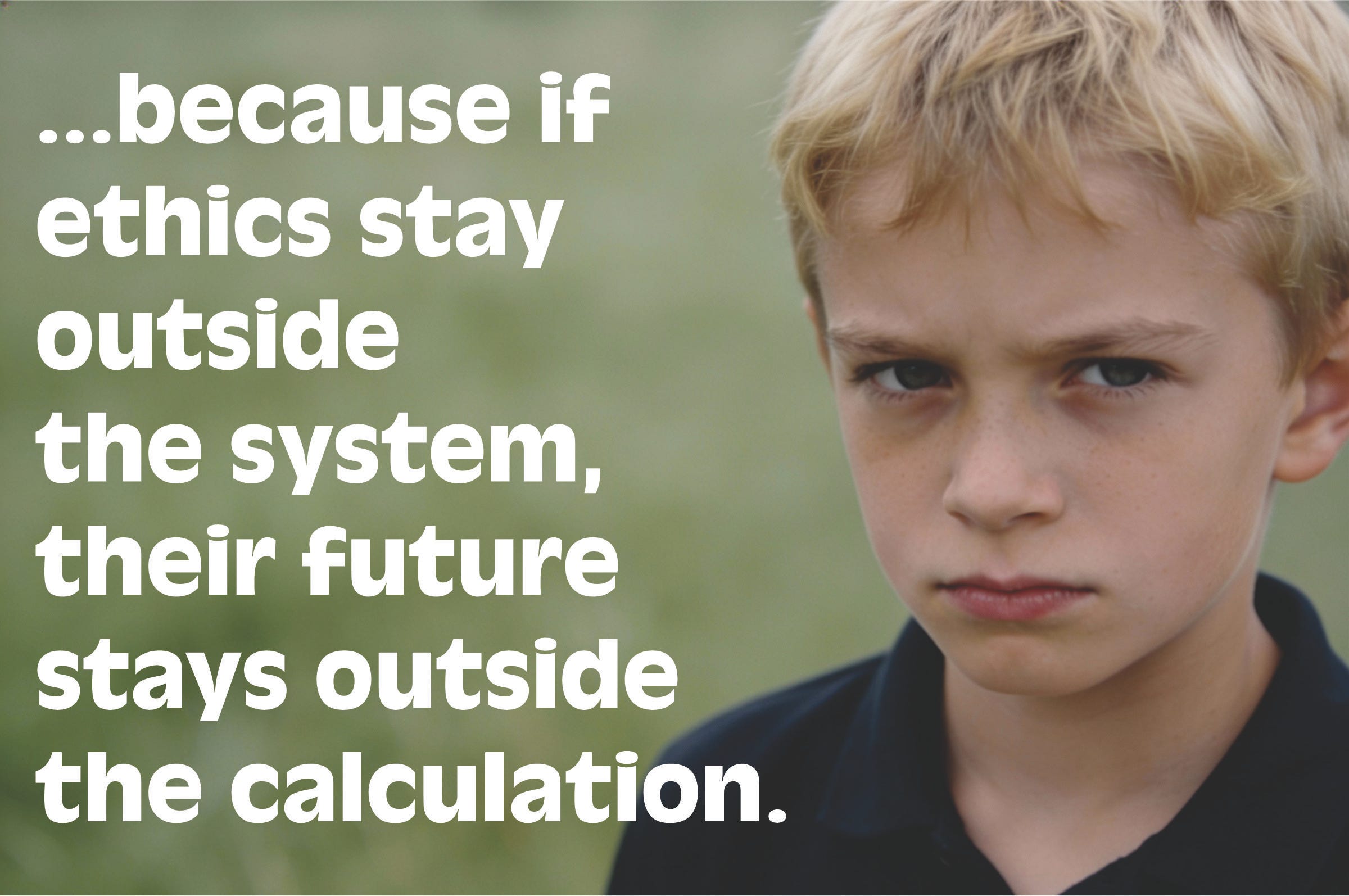
This isn’t a story about evil executives or corrupt corporations—though both certainly exist. This is about something far more unsettling: How ordinary people, doing their jobs, following orders, and operating at maximum efficiency within well-designed systems, can collectively produce decisions so morally repugnant that each individual participant would be horrified to claim personal ownership.
The efficiency that Coase identified has a dark twin. Let’s trace how we got here to see just how powerful his “efficiency machine” has become—and why it keeps producing the same ethical failures under different labels. For this analysis, it helps to follow the evolution of “the Coasean firm” all the way to today’s debates over sustainability and ESG.
The modern corporation does not produce harm because people are unethical. It produces harm because ethical responsibility dissolves inside systems designed for efficiency.
First, let’s accept that Coase’s brilliant explanation of modern corporate organizational philosophy presents an almost impregnable theoretical framework—which makes even companies that seem to “misbehave” understandable: This lens presents corporations not as a band of villains, but as a “machine” whose sole product is “efficiency.”
However—and largely without conscious intent—the very design of that machine systematically fragments moral reasoning. Taking that foundation into consideration, we see that horrific corporate missteps are never just about bad products or fraud; they’re about how the mechanics of the firm itself create a fertile environment for collective ethical abdication.
When we trace the path from the mega-conglomerates of the 1970s to today’s debates over Environmental, Social, and Governance (ESG) principles, we see the same Coasean dynamics at play. The resistance to sustainability and the embrace of ESG backlash are not random corporate stubbornness. They are the predictable, systemic outcomes of an organizational model built to minimize transaction costs, maximize shareholder value, and diffuse responsibility. We will explore how that system responded—and continues to respond—to the rising tide of sustainability and ESG.
The Conglomerate Era: When Bigger Became Better (and More Compartmentalized)
By the 1960s and 1970s, Coase’s theory had evolved from academic insight to corporate religion. The era of mega-corporations arrived with a vengeance. Conglomerates like ITT (International Telephone & Telegraph), Litton Industries, Gulf & Western, and Textron dominated the business landscape, acquiring unrelated businesses at breathtaking speed. One reporter gushed that “it is theoretically possible for the United States to become one vast conglomerate.” It was wild.
The underlying logic was pure Coasean efficiency—taken to its extreme. If firms existed to minimize transaction costs, then bigger firms with professional management and shared resources should be even more efficient.
Therefore, conglomerates developed multi-tiered pyramid structures, with holding companies controlling partially-owned subsidiaries, which in turn controlled their own subsidiaries. The theory held that these structures would create “greater accountability” through a professional “high command” that could allocate capital and management more effectively than any specialized firm.
Once efficiency becomes the organizing principle of the firm, moral coherence becomes an accidental byproduct—if it survives at all.
That’s how the belief structure evolved: a vision of an efficient pathway to “greater accountability.” But what actually emerged was something quite different. These sprawling organizations created unprecedented distance between decision-makers. Layers of hierarchy stretched longer. Chains of command became more complex. Each division operated with its own metrics, its own targets, its own local reality. The very structure that promised superior coordination instead produced fragmentation. And in that fragmentation, something crucial got lost: The ability to see the whole, to trace cause to effect, to connect a decision in one silo with its consequences in another—or in the outside world.
Friedman’s Doctrine: The Intellectual Framework for Moral Simplification
In September 1970, as conglomerates reached their zenith, Milton Friedman published an essay in The New York Times that would define corporate ethics for half a century. Its headline said everything: “The Social Responsibility of Business Is to Increase Its Profits.” Friedman’s argument was straightforward: Corporate executives are employees of shareholders, and their only responsibility is to make as much money as possible “while conforming to the basic rules of society, both those embodied in law and those embodied in ethical custom.”
However, unlike laws—which come with strong enforcement structures—“ethical custom” operates primarily under voluntary constraint. And in the modern firm, volunteerism of any kind is a challenging concept to institutionalize. Therefore, unfortunately, the second part of the framework proved harder to preserve in the conglomerate frame than Friedman may have realized at the time.
As a result, the Friedman Doctrine—also called “shareholder primacy”—provided executives with a devastatingly simple decision rule. When faced with a complex ethical question involving multiple stakeholders, the answer was clear: Maximize shareholder returns. Don’t worry about broader social consequences; that’s the job of government and individuals spending their own money. Your job is profit.
Whether Friedman’s essay actually caused the shift toward shareholder primacy or merely reflected trends already underway remains debated. But what’s undeniable is that it provided intellectual cover for a particular kind of moral reasoning—or rather, moral narrowing. Complex questions involving trade-offs between safety, environmental harm, worker welfare, and profit could be resolved with a single metric: The bottom line. This wasn’t intrinsically “evil”—it was simply efficient… and Coasean.
Once you put this simplified moral framework on top of sprawling conglomerate structures—aiming for maximum efficiency—the stage was perfectly set for the next big test: The emergence of environmental consciousness and sustainability in the 1970s.
The 1970s—Sustainability as an Inefficient Transaction Cost
When the concept of “sustainability” began seeping into public consciousness in the early 1970s—fueled by Rachel Carson’s Silent Spring (1962) and the first Earth Day (1970)—it landed in a corporate world perfectly architected to reject it.
The Conglomerate Mindset: Examining the landscape of the time, we see that this was the era of sprawling, compartmentalized conglomerates. Each division had its own P&L (Profit & Loss Statement), its own targets, and its own insulated reality. Then suddenly “Sustainability” pops up—a holistic, long-term, and often cross-disciplinary concern. This was the absolute antithesis of efficient specialization. It required seeing interconnectedness—which the firm’s structure was designed to obscure so as to prevent distraction from the segregated efficiency of silos.
Friedman’s Filter: Milton Friedman’s 1970 doctrine provided the perfect intellectual weapon. Sustainability initiatives, unless they directly and immediately increased profits, could be dismissed as a misuse of shareholder funds—a violation of management’s core “social responsibility.” Questions about pollution, resource depletion, or community impact were not “operational problems”; they were externalities to be managed legally or through Public Relations—not internalized ethically.
The Moral Distance: Just as Ford engineers saw a gas tank as a cost-benefit problem and tobacco scientists filed internal reports few acted upon (more on these examples later), environmental concerns became someone else’s department—a regulatory affair for lawyers or a publicity issue for PR. The corporate veil and diffusion of responsibility allowed executives to see environmental damage not as a moral failing of the corporation, but as a regrettable, but likely unavoidable, byproduct of efficient production—best handled by settlements and lobbying.
The result? A systemic—and not necessarily conscious—but nevertheless “baked-in” refusal. Embracing sustainability meant slowing down, retooling assembly lines (like Ford’s), increasing costs, and muddying clear profit metrics. In the Coasean firm, that was absolute definition of “inefficiency.”
The Legal Architecture: Corporate Personhood Without Full Personal Responsibility
Parallel to these economic developments, the legal structure of corporations created another layer of moral distance. Corporate personhood—the legal fiction that a corporation is a “person” separate from its owners and employees—has profound ethical implications that are rarely examined.
Corporations enjoy many rights of persons: they can own property, enter contracts, and sue or be sued. But they lack certain responsibilities. Most importantly, individual shareholders are shielded from corporate debts and damages. When a corporation commits harm, individual employees can be held liable for their own actions, but generally not for the corporation’s collective behavior. This creates a peculiar hazard regarding corporate moral responsibility: The entity making decisions isn’t fully accountable—and the individuals within it can claim they were just following corporate directives or working within their assigned roles.
The corporate veil does more than protect shareholders legally—it provides psychological distance. When you work for General Motors, you’re not personally building cars that might have safety defects; you’re calculating cost-benefit ratios, or drafting contracts, or managing supplier relationships. The corporation acts. You just do your job.
The Psychological Machinery: How Good People Enable Bad Outcomes
The structural and legal scaffolding created conditions for something social psychologists had already documented in laboratory settings: The diffusion of responsibility. When multiple people are present, each individual feels less personally accountable for taking action. In emergency situations, bystanders assume someone else will help. In organizations, employees assume someone else—someone higher up, someone in another department, someone “whose job it’s actually supposed to be”—bears responsibility for moral questions.
This diffusion operates through three stages. First, event perception: recognizing something requires attention. Second, social scanning: looking to others for cues about how to respond. Third, responsibility dispersion: this is the internal rationalization that someone else is better positioned to act. In corporate settings, these stages play out through organizational structure. Complex chains of activity obscure who should respond. Hierarchies create clear lines showing that moral decisions belong “higher up.” Group decision-making distributes accountability until no single person owns the outcome.
Closely related is organizational moral disengagement—the collective suspension of morality that occurs when organizations develop shared mechanisms for justifying unethical activities. These mechanisms include: (1) Displacement of responsibility (“just following the rules and procedures from above”); (2) Diffusion through division of labor (“no clarity about how decisions are made so no one can be held accountable”); and (3) Moral justification through “corporate-speak” that makes harmful actions sound palatable. When members perceive their organization to be morally disengaged, they become more likely to participate in unethical behavior and remain silent about misconduct.
Stanley Milgram’s famous obedience experiments of the 1960s demonstrated that ordinary people will administer what they believe are dangerous electric shocks to strangers when directed by an authority figure. Interestingly, the experiments were conducted the very same month the trial of Holocaust perpetrator Adolf Eichmann concluded. They revealed “the surprising strength” of the human tendency to obey authority—and that “many people are willing to obey destructive orders that conflict with their moral principles and commit acts which they would not carry out on their own initiative.”
We can summarize Milgram’s findings with this sentence: Once humans accept “an authority’s right to direct” our actions, we relinquish moral responsibility and “allow that person to define for us what is right or wrong.”
With the Eichmann matter refreshing the Nuremberg Trials in the collective consciousness of the time, Milgram’s findings were then widely used to warn business students about the unethical demands that might be made by bosses. This has tapered off somewhat since then.
Either way though, the corporate implications are clear: Hierarchical structures don’t just organize work efficiently; they also create conditions where people psychologically transfer moral agency upward. The result is what philosopher Hannah Arendt, reporting on the Eichmann trial, called “the banality of evil”—not extraordinary monsters, but ordinary people following orders, doing their jobs, and importantly, absolving themselves of responsibility because decisions were made by superiors.
In corporations, this manifests through what sociologist Robert Jackall identified as five informal rules that govern organizational behavior: (1) Never go around your boss; (2) Tell your boss what he wants to hear; (3) If your boss wants something dropped, drop it; (4) Anticipate your boss’s wishes without forcing him to act as a boss; (5) Your job is not to report what your boss doesn’t want reported, but to cover it up.
These aren’t written policies. They’re the lived reality of organizational life—the actual code by which people operate when formal ethics statements collide with career survival. When members perceive their organization to be morally disengaged, they become more likely to participate in unethical behavior and remain silent about misconduct.
Once this architecture of distance, obedience, and moral disengagement is in place, any framework that tries to re-inject ethics into the core of the firm will feel destabilizing. That is exactly what happened when ESG entered the scene in the early 2000s.
The 2000s—ESG as a Threat to the Command-and-Control Model
When the term “ESG” was coined in the early 2000s, it represented more than a new concern; it represented a new paradigm for evaluating corporate success. It asked firms to be accountable to a broad set of stakeholders (E, S, and G) over the long term. The corporate system—now even more globalized and optimized for shareholder returns—hardened its resistance. Why? Let’s consider:—
The Metric Problem: ESG introduced non-financial metrics (carbon footprint, worker safety, board diversity) into the evaluation of the firm. For organizations built on optimizing clear, financial KPIs (Key Performance Indicators), these were vague, complex, and difficult to subordinate to the bottom line. They disrupted the “devastatingly simple decision rule” of shareholder primacy.
A Challenge to Hierarchy: True ESG integration requires listening to “outside” voices: communities, environmental scientists, lower-level employees. This flattens information flow. How could this ever work? After all, corporate hierarchies institutionalize obedience and discourage the idea of challenging authority. ESG demanded the very debate and dissent that cultures like Volkswagen’s environment of “eschewing debate and dissent” were engineered to suppress. (More on this later.)
Responsibility Redefined: ESG implicitly demands that the corporation itself, as a legal person, bear moral responsibility for its broad impacts. This directly attacks the psychological and legal distance so carefully constructed. It asks the accountant, the engineer, and the manager to see their work as part of a whole system with ethical consequences—precisely the moral reasoning that compartmentalization had so conveniently disposed of.
The resistance wasn’t merely philosophical; it was structural. ESG was understandably perceived as a threat—an invasive virus with the potential to infect the operating system of the modern firm to its detriment.
To see how this plays out in practice—long before ESG became a buzzword—it helps to look at concrete cases—some of which we touched on earlier. These examples show how the efficiency machine produced bad outcomes that no one within the machine would ever willingly own.
Case Studies: The Theory Made Flesh
Theory always becomes real through specific cases. These four examples—spanning from the 1970s to today—illustrate how Coase’s efficient firm evolved into an ethical disaster machine.
Ford Pinto: When Cost-Benefit Analysis Meets Human Life
The Ford Pinto entered the U.S. market in 1970 with a mission: Stem the flow of sales to Japanese automakers. Lee Iacocca demanded a small car that weighed under 2,000 pounds and cost under $2,000. What emerged was a hit—and quickly, infamous. The Pinto burst into flames if struck from behind at speeds over 25 miles per hour.
Here’s what positions this case as the archetype for the premise we’re discussing: Ford engineers discovered the defect during pre-production testing. They explored solutions costing as little as $1 per car. Ford owned the patent on a much safer gas tank. But assembly lines were already tooled when engineers found the problem. According to Ford staff, the word “safety” was “taboo” with Iacocca. One engineer recalled: “That person would have been fired. Safety wasn’t a popular subject around Ford in those days. With Lee it was taboo. Whenever a problem was raised that meant a delay on the Pinto, Lee would chomp on his cigar, look out the window and say ‘Read the product objectives and get back to work.’”
The accounting team calculated that settling lawsuits would be cheaper than fixing the problem. The lobbying team fought federal safety standards for eight years. Engineering knew. Accounting knew. Legal knew. Management knew. Each group operated at maximum efficiency within its assigned function. The collective result? As many as 900 people died in catastrophic fires. No single individual made a decision to kill 900 people. But 900 people died anyway.
Tobacco Industry: Compartmentalizing Knowledge of Mass Death
By the mid-1950s, tobacco industry insiders “clearly knew their product was dangerous.” Internal documents reveal a stark timeline: In 1946, Lorillard’s director of research commented privately that “certain scientists and medical authorities have claimed for many years that the use of tobacco contributes to cancer development in susceptible people. Just enough evidence has been presented to justify the possibility of such a presumption.” In 1947, an internal report to Lorillard acknowledged “carcinogenic benzopyrene in tobacco tars.” In 1953, R.J. Reynolds’ internal survey concluded that tobacco was “an important etiologic factor in the induction of primary cancer of the lung.” In 1958, British American Tobacco scientists found that ‘with only one exception, all consulted experts believed the cancer connection had been adequately confirmed.’
What did the companies do with this knowledge? In December 1953, CEOs of the six largest tobacco manufacturers met at the Plaza Hotel in Manhattan and developed “a far-reaching plan to refute the accumulating evidence, using adverts, ‘white papers,’ press releases and corporate schmoozing with popular science writers and journalists.” In 1973, the Tobacco Institute hired market research firms to measure the impact of its denialist propaganda, including a film called “Smoking and Health: The Need to Know,” shown to hundreds of thousands—including high school students.
The scientists knew. The lawyers knew what the scientists knew and advised executives against admitting it publicly—a pattern of institutional dishonesty that has eroded public trust in corporate and scientific authority for generations.
The public relations teams created denial campaigns. The lobbyists fought regulations. Each operated within professional norms: (1) Scientists documented truth in internal reports. (2) Lawyers provided legal counsel about disclosure risks. (3) PR professionals executed communication strategies. (4) Lobbyists represented client interests. Nobody set out to kill millions of people. But millions died anyway.
Wells Fargo: Quotas, Fear, and 3.5 Million Fake Accounts
Between 2011 and 2016, Wells Fargo employees opened 3.5 million fake accounts without customer consent. The bank fired 5,300 mostly lower-level workers. CEO John Stumpf testified to Congress that this “wrongful sales practice behavior goes against everything regarding our core principles, our ethics and our culture.” Former employees watching the testimony had a different reaction. As one put it: “Bull****!” Another explained: “That’s the whole foundation of Wells Fargo. It’s cross-sell, cross-sell, cross-sell.”
The culture was brutally clear. Daily sales quotas pushed the mantra “Eight is great”—eight products per customer. Daily reports publicly compared individual sales numbers, shaming low performers and praising high achievers. Former employees described a “soul-crushing” culture of fear and daily intimidation. One manager sent emails “peppered with exclamation points and capital letters” urging employees to “ignore the bosses and get sales up at any cost.” When workers refused to open fake accounts and alerted the ethics department, they were fired. In 2013, the Los Angeles Times published an exposé. Nothing changed. In 2014, the bank held multi-day ethics seminars “to stop the practices.” Nothing changed—because the impossible quotas didn’t change.
Former employees reported that wrongdoing was “widespread even at the bank branch in the very building where the CEO and senior management team worked.” Wells Fargo’s own internal investigation concluded that “corporate control functions were constrained by the decentralized structure.” Here’s how it worked: (1) Sales managers set quotas; (2) Branch employees met them, however possible (even if through fraud); (3) Regional managers reported the expected numbers. (4) Senior executives evaluated performance based on achievement of targets set. (5) Compliance held seminars. Each function operated efficiently within its decentralized silo. And the system produced 3.5 million fraudulent accounts.
Volkswagen: Engineering Under Pressure
In 2006, Volkswagen engineers faced a problem: They couldn’t design a diesel engine that met stricter U.S. emissions standards within the cost and timeline constraints imposed by management. So they created software “defeat devices” that detected when vehicles were being tested and temporarily reduced emissions. Eleven million vehicles were affected worldwide—including my own Volkswagen diesel Jetta Wagon.
The context was “Strategy 2018”—management’s goal to make Volkswagen the world’s number one automaker. As mentioned earlier, this ambition created a corporate culture described as “eschewing debate and dissent.” It produced a “cutthroat and autocratic work environment” where workers remained “quiet about questionable” decisions. The environment prioritized “rapid problem-solving over thorough analysis.” Engineers were forced to “either find cheaper alternatives to address higher regulatory standards, or possibly lose their jobs.”
Hanno Jelden, a manager on trial for the scandal, testified that he “alerted his superiors about the software responsible for the so-called ‘Dieselgate’ scandal but felt compelled to remain silent due to pressure.” Other defendants claimed they either “were unaware of the manipulation or had informed their superiors about it.” The engineers who created the defeat devices operated under impossible demands. The managers who set those demands were pursuing corporate strategy. The executives who crafted that strategy were competing to increase shareholder returns in a brutal global market. Each level made rational decisions within their scope of responsibility. The collective outcome: Systematic fraud affecting millions of vehicles and causing immense loss of stakeholder value including: (1) direct costs, fines, penalties, and settlements exceeding $30–$35 billion; and (2) an additional initial drop in market capitalization of over $40 billion.
The Systems View: Why Ethics Breaks Down in Complex Organizations
What unites these cases isn’t individual “villainy” but systemic dysfunction. From a systems thinking perspective, organizations create conditions where the effects of our decisions are distributed, delayed, and sometimes invisible. Traditional ethics varies from corporate moral responsibility in that it operates through clear, bounded relationships between individuals. Corporate systems, on the other hand, require acting within open, dynamic systems where consequences ripple outward in ways no single decision-maker can fully anticipate or control.
Organizations develop what researchers call goal displacement—a phenomenon where “complying with bureaucratic processes becomes the objective rather than focusing on organizational goals and values.” Systems, once created, are likely to endure even when circumstances change. They take on lives of their own—often devoid of what society would recognize as “common sense.” Ford’s Pinto assembly line was already tooled. Wells Fargo’s sales quotas were already set. Volkswagen’s corporate strategy was already announced. In each instance, the system chugged along because stopping it—or fundamentally questioning it—would have been harder than letting it continue.
Here’s where the compliance paradox emerges: Research shows that “the majority of compliance failures are rooted in behavioral and cultural factors rather than technical deficiencies.” So what happens? Organizations respond by adding more controls, more procedures, more compliance requirements. But paradoxically, adding more controls invariably means adding more risk. And, not surprisingly, when controls multiply, employees experience “control fatigue.”
Typically, the added controls create new complexity—which leads to a sort of silent rebellion: Even dedicated team members may view the control regime as “overblown” and simply bypass the aspect they deem unnecessary. What matters is not the number of rules but a proper understanding of human behavior: Humans need to be grounded in ethical principles more than they need rules. Therefore, fixing this challenge requires—awareness, moral judgment, and ownership.
However, there can be a flipside to this, too: Researchers have found evidence of what is sometimes called the “high-jump bar effect”: Organization can aim to continually increase ethics—with standards being set higher and higher—until eventually the standards are so high the organization can’t meet them—and it fails spectacularly. Meanwhile, “standards erosion” occurs when people become “less committed to ethics [because] they believe that the introduction of new standards is never-ending.” The result can be that managers then “suboptimally implement a standard [i.e., deliberately undershoot the goal] to avert the introduction of a new standard”—which creates cultural conditions for unethical behavior.
Further, when organizations respond to ethical breakdowns by bolting on more controls instead of rebuilding moral coherence, they create fertile ground for something else: Ethics as performance. “ESG” has often become a prime example of this.
The Performative Turn—Symbolic Actions as Systemic Defense
Facing immense pressure from investors, consumers, and regulators, many corporations were eventually forced to “join the ESG bandwagon.” But the system adapted in a way that preserved its core efficiency logic: Performative ESG—instead of the real thing.
The Silo Solution: Just as tasks are divided, this kind of so-called “ESG” was often siloed into a new department—a Chief Sustainability Officer role, or a glossy CSR (Corporate Social Responsibility) report compiled by a separate team. This allowed the core business operations (the engine of efficiency) to continue unchanged. The “ESG” function, like the compliance seminars at Wells Fargo, became another box to check—a “control function” constrained by the decentralized structure.
Targeting the Visible, Ignoring the Core: Companies launched highly visible, discrete initiatives—a “green” product line, a diversity scholarship—while their core business model (reliant on fossil fuels, exploitative supply chains, hyper-aggressive sales quotas) remained untouched. It was ethics as public relations—not as the operational redesign that true ESG implementation demanded. It mimicked the already well-practiced “corporate-speak” that had always managed to make harmful actions seem palatable.
The Efficiency of Symbolism: Symbolic action is efficient. It satisfies external stakeholders with minimal internal disruption. It’s the organizational equivalent of “telling your boss what he wants to hear” while continuing with business as usual. It protects the hierarchy, the metrics, and the profit focus from a truly transformative—and therefore “inefficient” —reckoning (from a traditionally Coasean perspective).
Most sustainability efforts fail not because they are insincere, but because they are layered onto a system that was never designed to carry moral weight.
But even performative ESG proved too destabilizing for some. When a political opportunity arose to delegitimize ESG altogether, the efficiency machine seized it.
The Backlash Embrace (2017 to Present)—The System Seizes a Political Opportunity
The recent “ESG backlash,” fueled by partisan politics, did not surprise the corporate system; it offered a lifeline back to the familiar simplicity.
A Return to Simple Rules: For executives navigating the complex—and sometimes contradictory demands of ESG—the backlash (framing ESG as "woke," ideological, or anti-capitalist) provided a logical escape hatch. It allowed them to rhetorically revert to Friedman’s simple, efficient rule: We focus on profits for shareholders. This reduced cognitive dissonance and transactional complexity.
Diffusion Gets a Megaphone: The backlash was more than welcome to many because it also did something else: It allowed corporations to externalize the blame once more. Those who wanted could legitimately claim that resistance to ESG isn’t their moral failing; it’s simply a rational response to “political pressure” or “divisive agendas.” It created a new “authority” (political allies) to defer to—which further absolved internal moral agency. It became a collective moral disengagement—on a societal scale. In the United States, this dynamic fed into America’s conspiracy-oriented political culture and made ESG vulnerable to ideological capture—exacerbating structural barriers absent in other developed economies.
Protecting the Machine: Ultimately, embracing the backlash is a defense of the Coasean efficiency model. It rejects the notion that the firm should be responsible for messy, systemic problems. It argues that the machine works best when its purpose is singular and its moral compass is outsourced to “the market” or “the government.” The backlash provides the intellectual and political cover to stop the difficult work of integration and return to comfortable fragmentation.
In other words, the machine keeps doing what it was designed to do: Protect efficiency by diffusing and outsourcing moral responsibility—which brings us back to the most unsettling feature of this entire story.
The Uncomfortable Truth: Everyone Is Doing Their Job
In a well-functioning organization, people can do their jobs perfectly—and still produce outcomes no one would defend.
This brings us to the core uncomfortable reality that Coase couldn’t have foreseen in 1937: The very efficiency of the firm—its indisputable ability to organize production more effectively than markets through command-and-control hierarchies and specialized roles—creates the precise conditions for collective moral abdication.
Consider what happens in a well-functioning Coasean firm: (1) Tasks are divided for efficiency. (2) Roles are specialized to develop expertise. (3) Hierarchies establish clear authority. (4) Information flows through designated channels. (5) Performance is measured against specific metrics. (6) Each person optimizes their function. (7) Transaction costs are minimized. The firm operates at maximum efficiency.
But moral reasoning doesn’t get divided, specialized, hierarchized, or optimized. It gets lost. Therefore, corporate moral responsibility evaporates. The engineer sees a technical problem to solve under constraints. The accountant sees a cost-benefit calculation. The lawyer sees legal exposure to manage. The manager sees targets to hit. The executive sees shareholder value to create. Nobody sees the whole. Nobody owns the ultimate moral question: Should we be doing this at all?
This isn’t a failure of ethics training or code-of-conduct statements. As the report reference earlier pointed out, Wells Fargo had “a surveillance mechanism, a code of conduct, and a training video on ‘vision.’” None of it mattered because “ethical conduct was independent of ethical rules.”
Similarly, Enron had comprehensive compliance systems. Boeing had restructured its management of delegated authority. Volkswagen later implemented “extensive integrity and compliance programs.” The problem isn’t the absence of ethical infrastructure—it’s that the infrastructure operates within a system designed for efficiency—not moral coherence.
The Milgram experiments teach us that “once people have accepted the right of an authority to direct our actions, we relinquish responsibility to him or her and allow that person to define for us what is right or wrong.” Corporate hierarchies institutionalize this dynamic. You don’t challenge your boss’s priorities; you deliver on them. You don’t question the corporate strategy; you execute it. You don’t refuse the targets; you meet them. This is what being “a professional,” “a team player,” “a high performer” has come to mean.
Meanwhile, diffusion of responsibility ensures that when something goes wrong, everyone can point elsewhere. The engineers say they raised concerns but were overruled. The middle managers say they were following directives from above. The executives say they were serving shareholder interests and relying on reports from below. The board says they trusted management and had oversight systems in place. The accountability diffuses until it evaporates entirely.
What Coase’s Framework Makes Inevitable
Ronald Coase saw that firms exist because they’re more efficient than markets at certain tasks. He was right. What he couldn’t see—what perhaps nobody could see in 1937 before the era of mega-corporations, shareholder primacy, and globalized supply chains—is that this efficiency would come at an ethical cost.
Markets have many flaws, but they have one underappreciated virtue: In a market transaction, you see the other party. You negotiate directly. You own the decision to buy or sell. There’s no hierarchy to defer to, no role to hide behind, no system to blame. When things go wrong, the moral responsibility is uncomfortably clear.
Firms replace this direct accountability with something more efficient but also more ethically fragile: layers of mediation, specialized roles, hierarchical authority, and systematic processes. These structures minimize transaction costs brilliantly. They also minimize moral visibility. The distance between action and consequence stretches. The connection between individual decision and collective outcome blurs. The sense of personal responsibility dissolves into organizational diffusion.
The people working in firms aren’t less ethical than people in markets. They’re subject to different psychological and structural forces. Put a decent person in a market setting, and they bear full moral weight for their choices. Put the same person in a complex organizational hierarchy with specialized roles, performance metrics, and authority structures, and they can participate in collective decisions they would never make individually. This does not happen because they’ve become bad people, but because the system fragments the reasoning: Issues that feed into corporate moral-responsibility decisions are divided across components—where each micro-choice seems defensible in isolation.
The System We Inherited
The mega-corporations of the 1970s have evolved into even larger, more complex, more globalized entities. Supply chains span continents. Decision-making involves dozens of layers. Specialization has intensified. Performance measurement has become more sophisticated. Shareholder primacy, though recently questioned, remains the dominant paradigm. The structures Coase identified as efficient have become more elaborate, more optimized, more firmly entrenched.
Which means the ethical challenges have intensified too. When Boeing’s 737 MAX crashed twice, killing 346 people, investigations revealed a “disconnect between Boeing’s senior management and other members of the organization on safety culture.” The company’s own expert panel found that “decades of corporate decision-making eroded Boeing safety culture.” Internal emails showed engineers writing: “This plane is designed by clowns.” Another: “I feel uncomfortable with the safety approval.” Yet another: “We are pressured into signing off incomplete work.” Employees were “scared to speak openly.” Managers were “scared to escalate.” Leadership was “scared to slow down.” Why all this fear?
The verdict: “Culture created the defect.” Not technology. Not individual malice. Culture! We’re basically saying that the systematic organization of human activity that Coase identified as the firm’s essential function had produced an outcome that everyone involved would, individually, condemn. But sadly, the culture had condoned it.
The Question Remains
If people who work in firms are generally decent and ethical, why does the compartmentalization of their roles so often lead to a collective absence—or outright abdication—of ethical behavior? The answer, uncomfortable as it is, lies in the very nature of what makes firms efficient.
Coase taught us that firms exist to minimize transaction costs by replacing messy market coordination with efficient hierarchical direction. This creates enormous productive power. It also creates conditions where moral reasoning gets fragmented across specialized roles. As a result, (1) responsibility diffuses through hierarchical layers, (2) psychological distance grows between individual actions and collective outcomes, and (3) decent people doing their jobs can collectively produce decisions that no individual would defend.
This isn’t about business being amoral. It’s about efficiency and ethics existing in tension. The structures that make firms superior to markets at organizing production also make them inferior to markets at maintaining moral coherence. The very features that earned Coase the Nobel Prize—(1) command-and-control replacing negotiation, (2) specialization replacing generalization, (3) hierarchy replacing equality—turn out to have a shadow side that a young economist in 1937 could never have anticipated.
We’ve built an economic system on the efficiency of the firm. We’re now living with its ethical consequences. The question is no longer why decent people in firms collectively enable horrible decisions. The question is what we do about it now that we understand how the machinery works.
The Path Forward: From Principles to Levers
If the modern firm is an efficiency machine with a moral blind spot, then the task ahead is not to dismantle it—but to modify the points where moral reasoning can no longer be cleanly outsourced or compartmentalized. This requires moving beyond ethics as aspiration and toward ethics as design constraint.
Ethics does not fail in corporations because people lack values. It fails because values are asked to do the work that belongs to systems design.
The mistake most sustainability efforts make is treating ethics as an overlay—an added responsibility, a new department, a parallel reporting structure. That approach guarantees rejection. Real change occurs only when ethical exposure is wired directly into the firm’s existing decision logic.
Designing Ethics as a Constraint, Not a Value
Three levers matter more than all others. (For a more detailed examination of how these mechanisms create financial value, see my analysis of ESG as strategic infrastructure.)
First: Integrate ethical risk into core operational metrics—without renaming it “ethics.” Moral responsibility cannot survive as a standalone concept inside an efficiency-driven firm. But risk can. The most effective interventions therefore translate ethical exposure into variables the firm already respects: (1) Supply-chain fragility; (2) Regulatory latency; (3) Reputational decay; (4) Capital cost volatility; and similar items. When ESG factors appear inside core KPIs—not as separate dashboards, but as modifiers of performance—they stop being “values” and start being constraints. At that point, moral reasoning no longer depends on individual courage—it becomes embedded in the math.
Second: Collapse moral distance by forcing consequence visibility upstream. The firm’s greatest ethical failure is not malice but distance. Decisions are made far from their effects, by people shielded from feedback loops that would otherwise function as a corporate behavior correction mechanism. Leaders who want real change must therefore design systems that shorten the distance between decision and consequence: (1) Structured postmortems that include external harm; (2) Board materials that trace operational choices to downstream social and environmental outcomes; and (3) Escalation channels that protect—not punish—those who surface inconvenient truths. The goal is not blame, but coherence.
Third: Redefine efficiency to include resilience and permission to operate. A firm that externalizes risk onto society may appear efficient—until those externalities return as regulation, litigation, talent loss, or reputational collapse. True efficiency is not speed or cost minimization alone—it is the ability to operate sustainably over time without destroying the conditions that make operation possible. When leaders internalize this broader definition, ethics stops competing with performance and starts defining it.
None of these changes require moral grandstanding. They require design discipline. They treat ethics not as a matter of character, but as a property of systems. And that is the only level at which durable change is possible inside the modern firm.
Evolving the Machine Without Breaking It
For sustainability advocates, here’s the bad news—which may run contrary to some popular beliefs: Corporate resistance to sustainability and ESG is not a “conspiracy.” It is the natural immune response of an organism designed for a different purpose.
We therefore do well to ask ourselves if we can design firms that preserve efficiency while also recovering the high ground on corporate moral responsibility coherence. For the executive and the engaged reader, the implication is clear:—
Acknowledge the Design Flaw: We must move beyond blaming “bad apples” and recognize the systemic incentive problem. Ethical infrastructure (codes, sustainability officers, ESG training) fails when placed inside a machine optimized purely for transactional efficiency.
Re-wire the Metrics: We must fight the compartmentalization that severs moral reasoning. This means integrating ESG risks and opportunities directly into core financial and operational KPIs—which makes them part of everyone’s job, not a separate silo. It means rewarding long-term resilience over short-term profit.
Flatten Moral Distance: Leaders must actively design feedback loops that connect decisions with their consequences—bringing the voices of affected communities, frontline employees, and environmental realities into boardrooms and design labs.
Redefine “Efficiency”: The ultimate challenge is to expand the Coasean definition. Is a firm truly “efficient” if it externalizes its costs onto society and the planet, creating risks that eventually destroy shareholder value (as with Volkswagen’s “Dieselgate” or Boeing’s 737 MAX)? True efficiency must include resilience, reputation, and social license to operate.
These can all be accomplished with discipline and determination using the general guidelines in the previous section. And this is significantly more urgent than it may seem. The hard truth is that corporations can either start doing these things to update “the nature of the firm” now or watch as powerful regulators around the globe force the issue. As my readers know, new administrative structures are taking on a global character that will reshape how companies operate—using the inexorable power of permission (or withdrawal thereof) in all areas of trade and commerce.
The Operator’s Wedge: Where Change Can Actually Enter the Firm
Not everyone reading this sits in a boardroom or controls enterprise-wide strategy. Most are operators—directors, senior managers, functional leaders—working inside narrow lanes with limited authority. For them, the challenge is not understanding the system, but finding a way to act without triggering the very immune response this essay describes.
Change rarely enters the firm head-on. It enters sideways.
The most effective operators do not argue for “ethics” or “ESG.” They introduce wedges—small, defensible shifts that alter decision-making logic without announcing a moral revolution.
One wedge is metric substitution: Instead of adding new ethical goals, operators reframe existing ones. A procurement leader doesn’t argue for “responsible sourcing”; she argues that single-source suppliers increase geopolitical and operational risk. A sustainability lead doesn’t argue for emissions reduction; he argues that carbon intensity is becoming a proxy for future cost of capital. The language is familiar. The implication is not.
Another wedge is forced visibility. Operators quietly redesign reporting so that uncomfortable information cannot be cleanly ignored: trend lines instead of snapshots, lag indicators tied to earlier decisions, narratives that connect performance to downstream effects. Nothing about the firm’s values changes—but its ability to continue using ignorance as a pretext does.
A third wedge is decision inheritance. Instead of asking for permission to change strategy, operators simply embed constraints into the options they present upstream. By the time leadership chooses, the ethically reckless paths are already absent—not forbidden, simply made indefensible on the firm’s own terms.
None of these moves require moral heroism. They require systems literacy. They work because they respect the reality of the firm as it is, while subtly shifting what it can plausibly do next.
This is how operators survive inside flawed systems without becoming complicit in them. Not by standing outside the machine—but by learning exactly where to apply pressure from within.
Here’s the Bottom Line
Let’s understand where we are: Coase explained why the firm exists. Our task is to prove it can exist without demanding ethical oblivion as the price of admission. The journey from the ethical abyss back to solid ground begins not by dismantling the efficiency machine, but by giving it a conscience that it cannot compartmentalize.
That would be an update worthy of Coase’s original brilliance: Not abandoning the firm but evolving it into a structure that serves both efficiency and ethics. We want a structure where doing your job doesn’t mean abandoning your conscience. Where the collective outcome reflects—rather than betrays—individual moral commitments. Where the distance between decision and consequence shortens rather than stretches. Where accountability stays visible rather than diffusing into the organizational mist.
The most dangerous illusion modern organizations offer their leaders is that “doing your job well” absolves you of responsibility for what the system produces.
We need the Coasean firm to continue its existence. The challenge now is showing that firms can exist without requiring us to check our moral agency at the organizational door. This isn’t just about ESG. It’s about evolving “the nature of the firm.”
It’s the most powerful organizational tool of the modern economy. Let’s not allow it to self-destruct. We can actively support the emergence of a new breed of “the firm” so it can survive—and deserve to survive—in the rapidly changing market environment of the 21st century.